-
-
011- 69313821

011- 69313821
The first step towards creating an attractive Statement of Purpose (SOP) is following the correct SOP format. Whether it’s for SOP for Undergraduate, SOP for Masters, or SOP for MBA, clarity, organization, and purpose are essential. According to QS Top Universities, over 70% of top global institutions including Harvard University, Stanford University, MIT, University of Oxford, and Cambridge University, consider the SOP a key factor in admissions decisions.
A properly presented SOP looks, reads, and flows coherently, having your academic background and goals, and motivation in a well-organized manner, typically 800-1,000 words. The challenge? When most applicants undermine themselves or lack the kind of structure in their writing, they drop their chances.
This blog will show you how to respect the SOP format, what sections should be included, and how to come up with one that will grab attention. This guide makes sure that your SOP is on target, whether you are developing your first draft or doing final touch-ups.
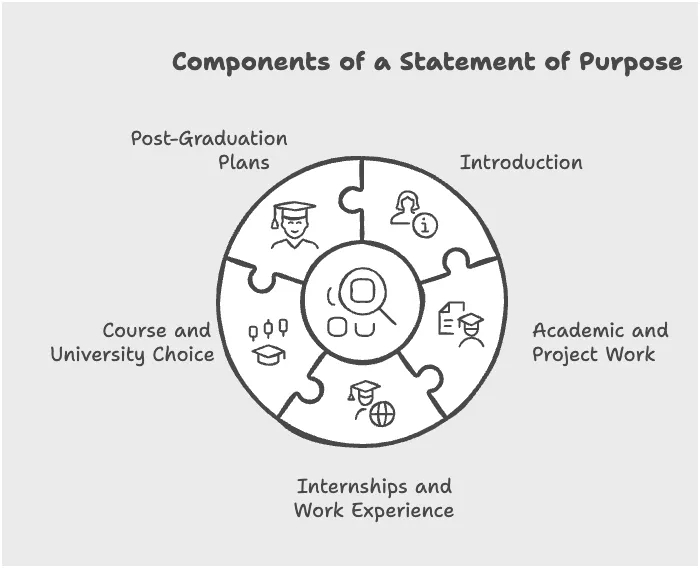
Universities often look at your SOP format before reading your content. A clean layout shows effort, professionalism, and attention to detail. Whether you're applying for an undergraduate, MS in the USA, MBA abroad, or PhD in Germany, your statement of purpose format must follow basic academic writing rules.
| Element | Recommended Format |
|---|---|
| Word Count | 500 to 1,000 words (check university limit) |
| Font & Size | Times New Roman or Arial, size 11 or 12 |
| Spacing | 1.0 or 1.15 line spacing |
| File Format | Always submit as PDF |
| Writing Style | Formal, direct, and clear |
Use this SOP formatting checklist for undergraduate, master’s, MBA, or PhD applications abroad.
SOP format varies by country. An SOP for Canada highlights career goals, while the USA SOP format blends academics and personal growth. For Germany, keep it research-focused and technical. Use the table below to align your SOP structure with each country’s expectations:
| Country | SOP Length | Tone & Structure |
|---|---|---|
| Canada | 800–1000 words | Personal, career-oriented |
| USA | 750–1000 words | Balanced, achievement-focused |
| Germany | 500–750 words | Technical, academic, research-driven |
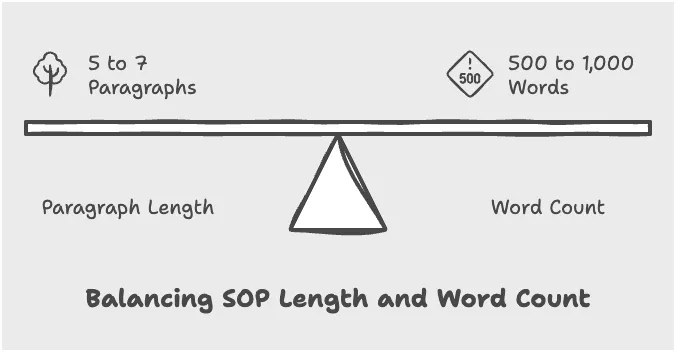
Most good SOPs are about 5 to 7 paragraphs long. That’s usually enough to tell your story without dragging it or rushing through things. Each paragraph should have a clear point, and the flow should feel smooth—not like a checklist.
| Do This | Avoid This |
|---|---|
| Write in full paragraphs | Using bullet points or subheadings |
| Keep your tone formal and personal | Using slang or casual phrases |
| Tailor the SOP for each course/university | Sending the same SOP to every university |
| Save and upload your SOP as a PDF | Submitting Word or editable files |
| Paragraph | What to Include |
|---|---|
| Intro | Start with your course goal + one reason why you're applying |
| Academic | Recent education, subjects, certifications, final-year projects |
| Experience | Internship, work experience, soft skills, tools used |
| Why This Program | Mention course modules, labs, professors, rankings |
| Career Goals | Short-term and long-term vision, link to the course |
| Conclusion | Reaffirm fit, thank the committee, mention scholarships (if needed) |
Start strong by stating your motivation, the program you're applying to, and what the SOP will cover.
| What to Include | Explanation | Example |
|---|---|---|
| A specific moment or realization | Share a real incident that sparked your interest | "A college workshop on ethical hacking sparked my interest in cybersecurity." |
| Exact course and university | Name the program and institution | "I’m applying to the MSc in Cybersecurity at TU Darmstadt for Winter 2026." |
| One-line summary of the SOP | Briefly preview your academic path, experience, and goals | "This SOP highlights how my academics, skills, and goals align with this program." |
Use this section to prove that your educational journey aligns with the course you’re targeting.
| What to Include | Explanation | Example |
|---|---|---|
| Degree, college name, and year | Mention your most recent or ongoing degree | "Completed B.Tech in Information Technology from XYZ Institute in 2023." |
| Relevant subjects or certifications | Highlight coursework or extra learning related to your target program | "Took electives in network security and completed a Python course on Coursera." |
| Key academic projects or thesis | Showcase applied learning and problem-solving | "Built a phishing detection ML model using Python and a dataset of 1,000+ URLs." |
| Research papers or seminars | Demonstrate academic initiative | "Presented a paper on secure cloud storage at a 2022 student conference." |
| Academic challenges (if any) | Address only if relevant and show growth | "Initially struggled with coding, but improved through self-study and projects." |
Showcase how your work experienceformal or project-based, prepares you for the program.
| What to Include | Explanation | Example |
|---|---|---|
| Job title, company, duration | Keep it concise and dated | "Interned as a data analyst at ABC Analytics, Summer 2022." |
| Key responsibilities and results | Focus on outcomes, not just tasks | "Helped reduce churn by analyzing customer data with SQL and Excel." |
| Tools or platforms used | Highlight relevant hands-on tools | "Used Power BI to build dashboards and track performance metrics." |
| Soft skills or initiative | One quick example of leadership or problem-solving | "Improved project delivery with a new task tracking system after a missed deadline." |
| If no formal work: academic or personal projects | Don’t say “no experience”—talk about group work or self-led projects | "Led backend dev of a budgeting app using Firebase and ReactJS in a final semester project." |
A typical SOP format has 5–6 paragraphs covering your introduction, academic background, professional experience, reasons for choosing the course/university, career goals, and conclusion. Whether it’s for an SOP for Masters or SOP for USA, clarity, flow, and personalization are the most important elements.
Start by outlining your academic and professional journey, then explain why you’re applying and how the university aligns with your goals. A strong SOP connects your experiences with your aspirations, whether it’s an SOP for Undergraduate or an SOP for MBA, keeping it genuine and focused.
An SOP generally includes introduction, academic background, professional experience, reasons for the course/university, and career goals. Some applicants also add a short conclusion. This structure works for SOP for Masters and SOP for USA, ensuring your story is well-organized and coherent.
Understand the program expectations, brainstorm experiences, draft your SOP, refine for flow and clarity, and proofread. Following this SOP format ensures your SOP reflects your skills and potential, whether it’s for SOP for Undergraduate or SOP for MBA applications.
Focus on academic projects, workshops, or group assignments. Highlight what you contributed and learned. Universities care more about your potential than prior work, so even without experience, a well-structured SOP for Masters or SOP for USA can impress.
You can reuse the structure, but always tailor your SOP to each program. Mention unique courses, professors, or labs for each university. Generic SOPs rarely stand out, so customize your SOP for MBA or SOP for Undergraduate for maximum impact.
Yes, but keep them realistic. Show how the course will help you grow and the kind of roles you want. Clearly stated goals strengthen your SOP, whether it’s an SOP for Masters or SOP for USA, demonstrating that you’ve thought through your future.